Managing Screen Time for Toddlers: Singapore Parent Guide to Healthy Limits
Key Takeaways
- **Under 18 months:** Avoid screen time (video calls with grandparents are fine)
Managing Screen Time for Toddlers: Singapore Parent Guide to Healthy Limits
Let's be honest — if you've never handed your toddler a phone at a hawker centre so you could eat your chicken rice in peace, are you even a Singapore parent? Screen time is one of those topics where the guilt is real, but the practical reality of raising a toddler in a hyper-connected city means we need to be realistic, not idealistic.
This guide breaks down what the research actually says, what Singapore's own health guidelines recommend, and how to set limits that work for your family without losing your sanity.
> TL;DR — Key Takeaways > - Under 18 months: Avoid screen time (video calls with grandparents are fine) > - 18 months to 2 years: If any, only high-quality content with a parent co-viewing > - Ages 2–4: Maximum 1 hour per day of quality content > - What matters most: What they watch and how they watch it matters more than exact minutes > - Don't guilt-spiral: The occasional extra screen time during illness, travel, or a rough day won't derail your child's development
What Do the Guidelines Actually Say?
The World Health Organisation (WHO) and Singapore's Health Promotion Board (HPB) align closely on screen time recommendations for young children. Children under 2 should have zero sedentary screen time, while children aged 2 to 4 should have no more than 1 hour per day — less is better.
Here's the breakdown by age:
| Age | WHO / HPB Recommendation |
|---|---|
| Under 12 months | No screen time at all |
| 12–18 months | Avoid screen time; video calls okay |
| 18–24 months | If introduced, only high-quality programmes with parent co-viewing |
| 2–4 years | Maximum 1 hour/day; less is better |
| 5–7 years | Maximum 2 hours/day of recreational screen time |
Why it matters: A 2024 study published in JAMA Pediatrics found that children who exceeded 2 hours of daily screen time before age 3 showed measurably lower scores in communication and problem-solving by age 4. But — and this is important — the type of content and whether a caregiver was present made a significant difference in outcomes.
The Singapore Reality: Why It's Hard Here
Let's acknowledge the elephant in the room. Managing screen time in Singapore comes with unique challenges that the WHO guidelines don't account for.
Small living spaces. Many families live in HDB flats where it's hard to create separate play zones away from the TV. When your living room is also your play room, dining room, and WFH office, screens are always within reach.
Dual-income households. With the rising cost of raising a child in Singapore, most families are dual-income. After a full day of work and a commute, using 30 minutes of screen time so you can prep dinner is a survival tactic, not lazy parenting.
Helper and grandparent caregivers. If your child is cared for by a domestic helper or grandparent during the day, screen time rules can be harder to enforce. Your mother-in-law might genuinely believe that Baby Shark is educational — and having that conversation requires diplomacy.
The heat factor. Singapore's year-round heat and humidity mean outdoor play isn't always feasible, especially between 11am and 4pm. That shrinks the non-screen activity window considerably.
How to Set Realistic Screen Time Limits That Actually Work
The best screen time plan is one your whole household can actually follow. Perfection isn't the goal — consistency and quality are.
1. Establish "Screen-Free" Zones and Times
Pick non-negotiable screen-free moments rather than trying to police every minute. Most child development experts suggest these as your baseline:
- Meals — no screens at the dining table (yes, even at the hawker centre — we know, it's tough)
- 1 hour before bedtime — screens disrupt melatonin production and make bedtime harder
- In the bedroom — keep the sleep space screen-free
Start with just one rule and build from there. If hawker centre meals without a screen feel impossible right now, that's okay — start with home meals first.
2. Choose Quality Over Quantity
Not all screen time is equal. A toddler co-watching a 20-minute interactive episode with a parent is worlds apart from 2 hours of autoplay YouTube Kids.
- Better choices:
- Interactive apps where the child taps, answers questions, or solves problems (try QuizKin for free adaptive preschool quizzes that feel like play)
- Age-appropriate shows with clear narratives — Bluey, Daniel Tiger's Neighbourhood, Sesame Street
- Video calls with relatives
- Worse choices:
- YouTube autoplay or "surprise egg" unboxing videos
- Fast-paced content with rapid scene changes
- Any content with in-app purchase prompts targeting children
3. Co-View When Possible
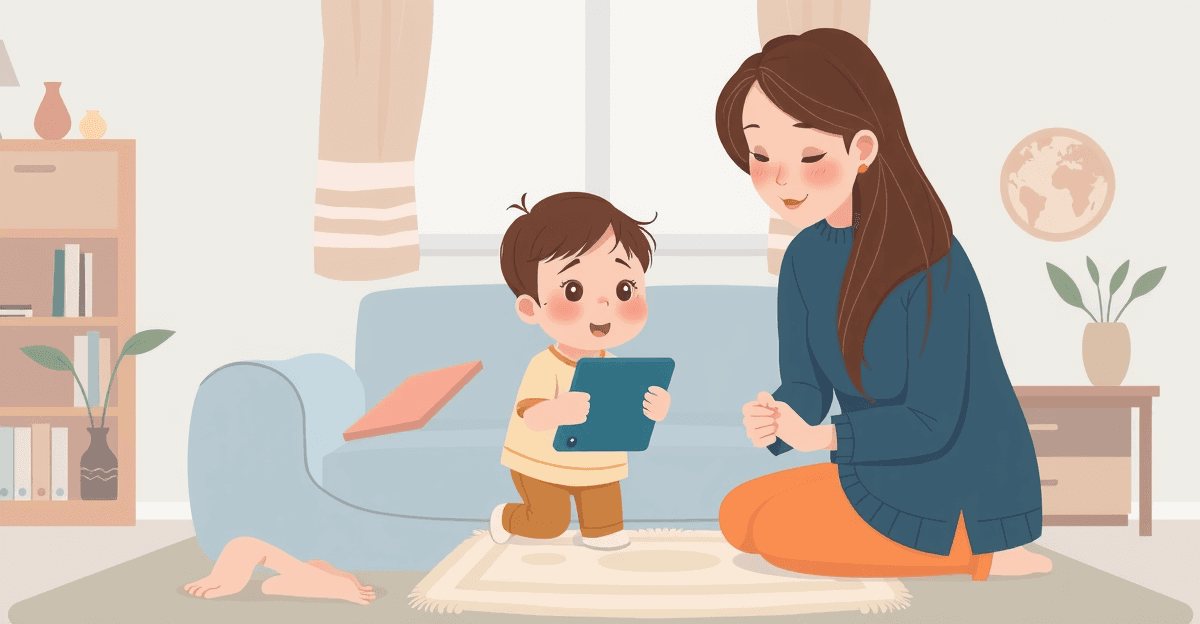
Sitting with your toddler and talking about what's on screen transforms passive watching into active learning. Ask questions: "What colour is that?" or "Why is Bluey sad?" This is called "joint media engagement," and research consistently shows it boosts the educational value of screen time.
You don't have to co-view every single time — that's unrealistic. But aim for at least half of their screen time to be shared with you or another caregiver.
4. Use a Visual Timer
Toddlers don't understand "10 more minutes." A visual sand timer or a timer app on your phone that shows time disappearing helps them grasp the concept. Give a 2-minute warning before screen time ends, and always have a transition activity ready — "When the timer's done, we're going to play with playdough."
The tantrum when the screen goes off is normal. It does get better with consistency. Usually within 1–2 weeks of holding the boundary, the meltdowns decrease significantly.
5. Create an "Instead" List
Write a physical list of 10–15 non-screen activities and stick it on your fridge. When your toddler asks for "iPad" (which they will — repeatedly), point to the list. Some ideas suited to HDB living:
- Water play in the bathroom (cheap, endlessly entertaining)
- Play-Doh or kinetic sand on a tray
- Building with Duplo or Mega Bloks
- Sticker books (Daiso has great ones for around $2.80)
- Helping with simple cooking tasks — washing vegetables, stirring
- Dance party (just play music — no screen needed)
- Indoor "treasure hunt" with household items
What About Preschool and Childcare Screen Time?
If your child attends a preschool or childcare centre, it's worth asking about their screen time policy. Under ECDA's guidelines for early childhood programmes, screen time in preschool settings should be limited and purposeful — not used as a time-filler.
Good questions to ask your child's centre:
- How much screen time is included in the daily routine?
- What type of content is used and for what purpose?
- Is screen time supervised and interactive?
Most quality preschools — including those under the Anchor Operator and Partner Operator schemes — use minimal screen time and focus on hands-on learning. If you're evaluating centres, check out our comparison of the best preschools in Singapore for more on what to look for.
Screen Time and Sleep: The Connection Singapore Parents Should Know
Singapore toddlers already sleep less than the global average — multiple local studies have flagged this. The National Sleep Foundation recommends 11–14 hours of total sleep (including naps) for children aged 1–2, and 10–13 hours for ages 3–5.
Screen time, especially in the evening, directly affects sleep quality. The blue light from devices suppresses melatonin, and stimulating content keeps little brains wired. If your toddler is fighting bedtime or waking frequently at night, cutting the pre-bedtime screen window is one of the most effective changes you can make.
Practical tip: Set a household rule of no screens after 7pm (or 1 hour before your child's target bedtime). Use that hour for bath time, books, and quiet play. It's a small shift that often yields noticeable improvements within a week.
When Screen Time Is Actually Helpful
We'd be dishonest if we didn't acknowledge that screen time can be genuinely useful in certain situations:
- Illness and recovery — When your child has HFMD (an almost inevitable rite of passage in Singapore childcare) and can't attend school for days, extra screen time is completely reasonable.
- Long waits — Polyclinic queues, specialist appointments at KKH or NUH, and long plane rides are all legitimate times to use screens as a tool.
- Parent mental health — If you're burning out, 30 extra minutes of Cocomelon while you take a breather is not going to harm your child. A parent who's regulated and present the rest of the day is far more valuable than a parent who's resentful and running on fumes.
- Language exposure — For multilingual Singapore families, screen time in Mandarin, Malay, or Tamil can supplement mother tongue exposure, especially if the home language is primarily English.
If your child's screen time occasionally exceeds guidelines on a tough day, extend yourself some grace. What matters is the overall pattern across weeks and months, not any single day.
Singapore Resources for Reducing Screen Time
If you're looking for structured support, Singapore has several resources worth knowing about:
- HPB's Healthy Meals, Active Play — a programme for preschools that includes guidance on managing screen time in early childhood settings
- Public libraries (NLB) — free storytelling sessions and toddler programmes at libraries islandwide are excellent screen-free outings. Check the NLB website for schedules.
- Community centres and ActiveSG — many CCs offer toddler playgroups, messy play sessions, and parent-child activities at subsidised rates ($5–$15 per session)
- Outdoor playgrounds — Singapore has hundreds of free playgrounds. Morning (before 10am) and late afternoon (after 4:30pm) slots beat the heat.
For parents considering enrichment classes as an alternative to screen time, we've put together a data-driven look at whether enrichment classes are worth it — including costs, what research says, and which types offer the best value.
A Sample Screen Time Routine for Toddlers
Here's a realistic daily routine for a 2–3 year old that keeps screen time under 1 hour:
| Time | Activity |
|---|---|
| 7:00am | Wake up, breakfast (screen-free) |
| 8:00am | Free play / attend childcare |
| 12:00pm | Lunch (screen-free) |
| 12:30pm | Nap time |
| 2:30pm | Afternoon snack, free play |
| 4:30pm | 20 min screen time — educational show with parent |
| 5:00pm | Outdoor play / playground |
| 6:00pm | Dinner (screen-free) |
| 6:30pm | 15 min screen time — video call with grandparents |
| 7:00pm | Bath, books, bedtime routine (screen-free) |
| 7:30pm | Bedtime |
The Bottom Line
Managing screen time for toddlers in Singapore isn't about perfection — it's about being intentional. Choose quality content, set consistent boundaries, and don't beat yourself up over the occasional extra episode. Your child needs a present, engaged parent far more than they need a screen-time-zero household.
At ParentLah, we believe that practical beats perfect every time. If you're juggling screen time alongside the financial demands of raising kids in Singapore, make sure you're tapping into all the government grants and subsidies available to parents — every bit helps.
You've got this.
---
Sources
1. WHO Guidelines on Physical Activity, Sedentary Behaviour and Sleep for Children Under 5 2. Health Promotion Board — Screen Time Recommendations 3. ECDA — Early Childhood Development Centres Act and Regulations 4. National Library Board — Children and Family Programmes 5. JAMA Pediatrics — Association of Screen Time With Developmental Outcomes 6. National Sleep Foundation — How Much Sleep Do Babies and Kids Need?
Frequently Asked Questions
How much screen time should a 2-year-old have in Singapore?
The WHO and Singapore's Health Promotion Board recommend no screen time for children under 2, and no more than 1 hour per day for children aged 2 to 4. In practice, many Singapore parents find that keeping to under 1 hour of high-quality content daily works well. The key is choosing age-appropriate, interactive content over passive watching.
Are learning apps like ABC Mouse or Khan Academy Kids okay for toddlers?
Interactive educational apps are a better choice than passive video content for toddlers aged 2 and above. Apps that require your child to tap, respond, or problem-solve are more beneficial than those where they just watch. However, they still count as screen time, so keep total usage within the recommended 1-hour daily limit and try to co-view when possible.
What can I do instead of screen time during hawker centre meals or MRT rides?
Pack a small activity bag with sticker books, crayons and a mini notebook, or small figurines. Mess-free colouring pads (available at Popular or Daiso) are great for hawker centre outings. For MRT rides, try 'I Spy' games, sing nursery rhymes quietly, or bring along a board book. It takes effort upfront, but toddlers adapt quickly when screens aren't the default option.
You might also like
Get Weekly Parenting Tips
Get practical parenting guides on costs, schools, and subsidies. No spam.
Related Articles
Screen Time for Kids: Singapore Parents' Evidence-Based Guide
What the research actually says about screen time for children, Singapore-specific guidelines, and practical strategies for managing devices in your family.
Online Safety for Children in Singapore: A Parent Complete Guide
Practical guide to keeping kids safe online in Singapore — screen time rules, parental controls, cyberbullying, IMDA regulations, and age-by-age digital safety tips.
Best Educational Apps for Preschoolers in Singapore (2026 Review)
Curated list of the best educational apps for preschoolers in Singapore. Covers literacy, numeracy, Chinese language, and creative apps — with honest reviews and age recommendations.